

From humble beginnings to reshaping the future of computing, NVIDIA’s co-founder and CEO is leading the charge into the age of artificial intelligence.
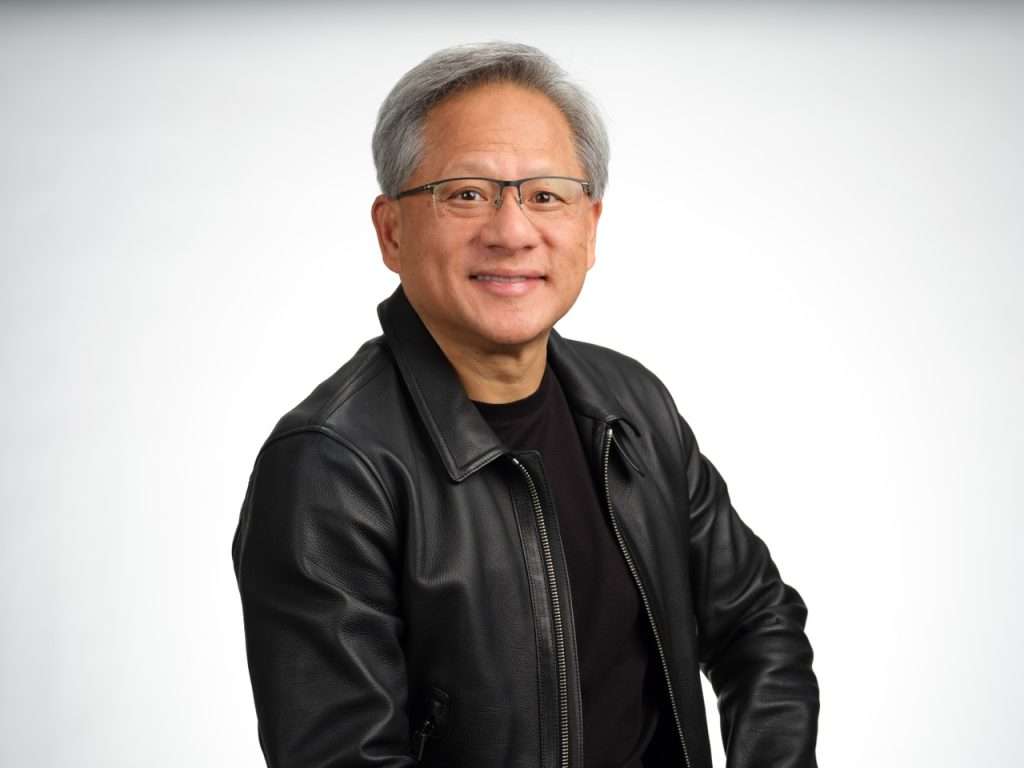
In the frenzied engine room of global innovation that is Silicon Valley, few names resonate with such intensity as Jensen Huang. Charismatic, sharp-witted, and forever clad in his signature black leather jacket, the co-founder and CEO of NVIDIA is not merely the face of the world’s most valuable chipmaker — he is the visionary force behind the AI revolution.
From transforming video gaming graphics into one of the most powerful infrastructures for artificial intelligence, to reshaping everything from healthcare to robotics and autonomous vehicles, Huang has steered NVIDIA from a three-man startup in a Denny’s diner to a $3.3 trillion titan. But the journey of the man himself is just as remarkable as the technology he pioneers.
From Cleaning Toilets to Building Empires
Born in 1963 in Tainan, Taiwan, Jen-Hsun “Jensen” Huang’s life took an early detour when his family sent him to live in the United States. Due to a misunderstanding, he ended up at a Kentucky reform school, scrubbing toilets and fighting off bullies — an experience he later credited with building resilience and independence.
After attending Oregon
State University and later Stanford, Huang entered the tech world through stints at LSI Logic and AMD. But it was in 1993, at just 30 years old, that he co-founded NVIDIA alongside Chris Malachowsky and Curtis Priem. With only $600 between them, the trio met regularly at a local Denny’s, scribbling ideas on napkins and dreaming of what computing could become.
Initially, NVIDIA focused on graphics processing units (GPUs) for gaming — a burgeoning market in the mid-90s. But Huang, ever the futurist, saw something no one else did: the immense parallel processing power of GPUs could do far more than render video games. It could power artificial intelligence.

The GPU That Ate the World
Under Huang’s leadership, NVIDIA began to pivot. The launch of CUDA (Compute Unified Device Architecture) in 2006 enabled developers to use NVIDIA’s GPUs for general-purpose computing, unlocking a new frontier. What followed was a quiet revolution: researchers realised that GPUs could train AI models exponentially faster than traditional CPUs. By the mid-2010s, NVIDIA chips were powering breakthroughs in everything from self-driving cars to medical imaging.
Fast forward to 2024, and NVIDIA had become the undisputed cornerstone of the AI economy. Its high-performance chips fuel data centres, scientific research, and generative AI models like OpenAI’s GPT and Google’s Gemini. The company’s latest suite of Blackwell Ultra and Vera Rubin chips, unveiled at the 2025 GPU Technology Conference (GTC), promises even more performance with lower energy consumption — a response to growing scrutiny over the environmental impact of large-scale AI training.
But Huang isn’t just building faster chips. He’s building platforms. At GTC, he announced the launch of NVIDIA Cosmos, a simulation platform capable of creating infinite digital scenarios for training AI — everything from traffic flows for autonomous vehicles to crisis management for emergency services. He also introduced Isaac GR00T N1, an open-source model designed to train humanoid robots with physical AI, turning science fiction into near-future reality.

Leadership in the Age of AI
What sets Huang apart is not only his technical brilliance but his clarity of vision. In an age of hype, he is a rare realist who articulates complex ideas without hyperbole. “AI is not magic. It’s mathematics,” he often reminds audiences. Yet he is also candid about its implications. “You’re not going to lose your job to AI. You’re going to lose it to someone using AI,” he warned recently at the Milken Institute Global Conference, stressing the need for continuous learning.
True to his word, Huang uses AI tools like ChatGPT and Google’s Gemini Pro daily as personal tutors. “I have my own AI tutors. I’m learning about quantum mechanics, the history of Europe, the causes of World War I,” he told a packed room. His message is clear: in the AI era, curiosity and adaptability are non-negotiable.
He’s equally passionate about cultivating talent. Internally, NVIDIA is known for its deep culture of autonomy, speed, and clarity. “The more information people have, the better decisions they make,” Huang said in a 2024 interview. “My job is to create the environment where great people do their life’s work.”
Balancing Innovation with Global Reality
Despite its success, NVIDIA has found itself caught in the crosshairs of global politics. Huang has been vocal about the challenges posed by U.S. export restrictions on advanced chips to China — a key market for the company. He likened the lost opportunity to “an entire Boeing” — not just a plane, but a full-scale company.
While he supports efforts to protect national security, Huang advocates for balanced policies that recognise the importance of global collaboration in advancing science and technology. “AI has no borders. The benefits — and the risks — are global,” he said.

Giving Back
Huang’s journey has not only changed technology but also inspired a new generation of leaders. In recent years, he has made generous philanthropic contributions, including $30 million to Stanford University and $50 million to Oregon State University to support supercomputing and engineering research. “I was a kid with no money, no connections, and barely any English,” he said. “That’s why I believe deeply in education — it changed my life.”
A Reluctant Rock Star
Despite his iconic status in tech circles — he is now routinely greeted with standing ovations and described as the “Steve Jobs of AI” — Huang remains refreshingly grounded. He often deflects praise to his team, credits his success to grit and luck, and prefers to talk about what’s next rather than what’s been achieved.
What lies ahead for NVIDIA and for Huang? Likely a deeper entrenchment in the very fabric of society — healthcare diagnostics, smart cities, digital twins, and yes, the metaverse. If Huang has his way, the future will not only be intelligent but beautifully engineered, inclusive, and astonishingly fast.
From scrubbing toilets in Kentucky to reshaping the very infrastructure of the 21st century, Jensen Huang’s story is one of persistence, purpose, and boundless ambition. As the world accelerates into the AI era, he stands not just at the forefront — but as its architect.